page five
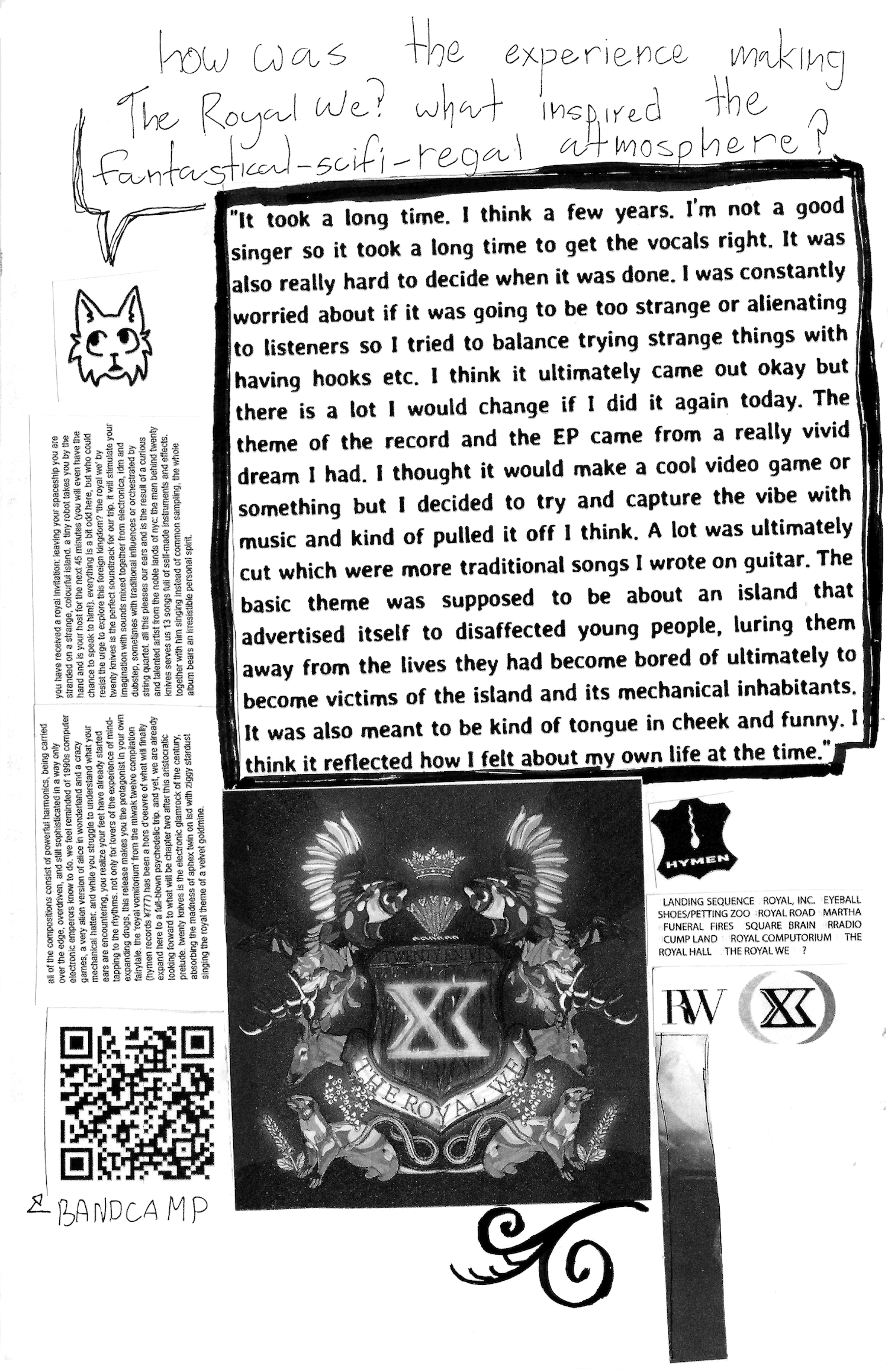
question: "how was the experience making The Royal We? what inspired the fantastical-scifi-regal atmosphere?"
answer: "It took a long time. I think a few years. I'm not a good singer so it took a long time to get the vocals right. It was also really hard to decide when it was done. I was constantly worried about if it was going to be too strange or alienating to listeners so I tried to balance trying strange things with having hooks etc. I think it ultimately came out okay but there is a lot I would change if I did it again today. The theme of the record and the EP came from a really vivid dream I had. I thought it would make a cool video game or something but I decided to try and capture the vibe with music and kind of pulled it off I think. A lot was ultimately cut which were more traditional songs I wrote on guitar. The basic theme was supposed to be about an island that advertised itself to disaffected young people, luring them away from the lives they had become bored of ultimately to become victims of the island and its mechanical inhabitants. It was also meant to be kind of tongue in cheek and funny. I think it reflected how I felt about my own life at the time."
page six
question: "were some of the songs on Live Fast & Die With A Broken Heart an early attempt and moving towards the sound that you wanted?"
answer: "Yeah definitely. I wrote that while I was still a teenager and it was going to come out on a Japanese record label called Murder Channel, run by a guy named Ume. He used to throw breakcore shows in Japan. Ultimately I don't think either of us were very happy with the record (he also had some health issues that prevented him from continuing the label for some time) and it ultimately never came out though I think it was leaked in a couple of different versions online. Although some people seemed to like it I didn't really think I had enough experience to pull off what I was trying to do at that time."
question: "what are your thoughts of the growing chronically online nature of these scenes?"
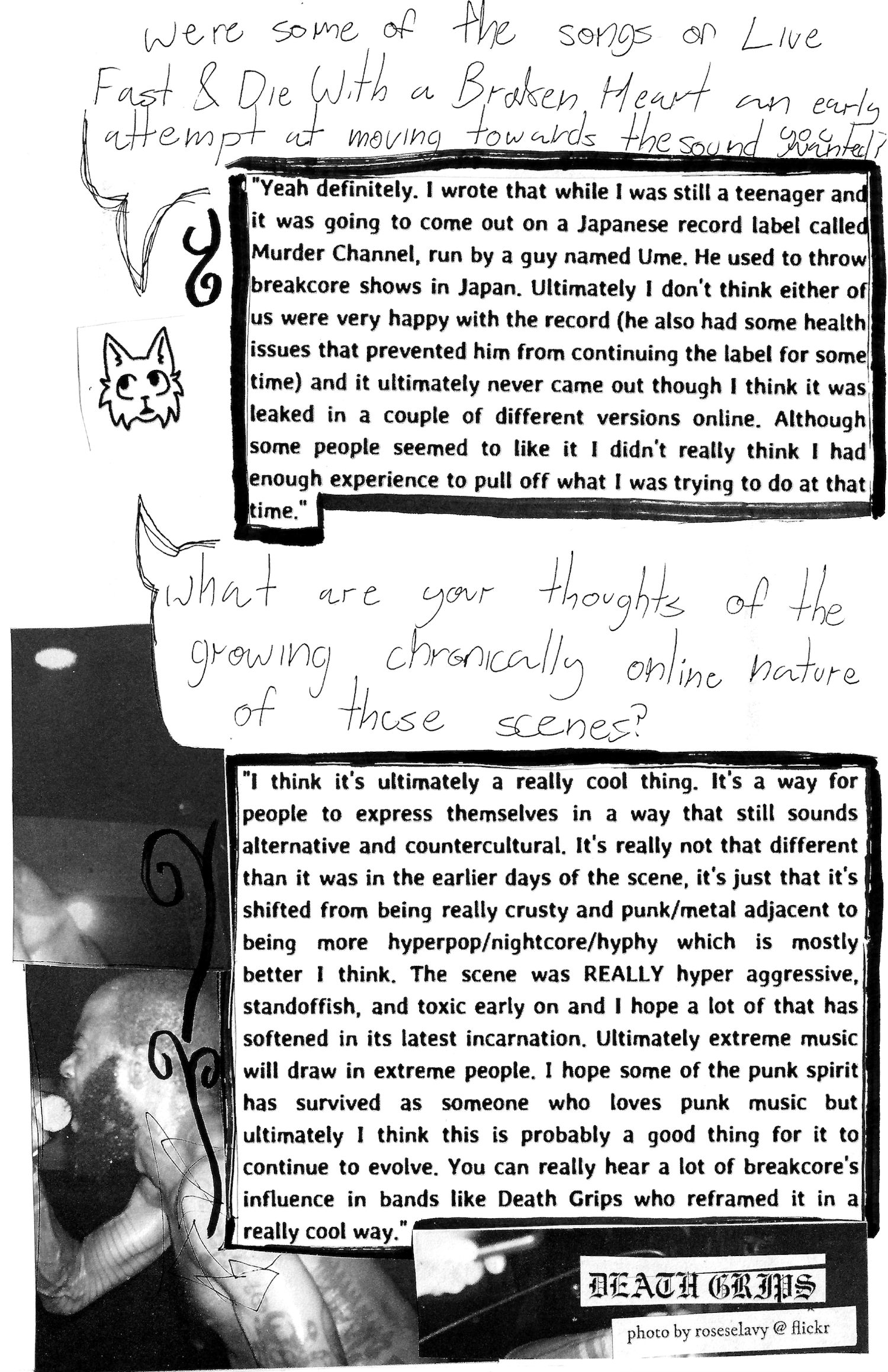
answer: "I think it's ultimately a really cool thing. It's a way for people to express themselves in a way that still sounds alternative and countercultural. It's really not that different than it was in the earlier days of the scene, it's just that it's shifted from being really crusty and punk/metal adjacent to being more hyperpop/nightcore/hyphy which is mostly better I think. The scene was REALLY hyper aggressive, standoffish, and toxic early on and I hope a lot of that has softened in its latest incarnation. Ultimately extreme music will draw in extreme people. I hope some of the punk spirit has survived as someone who loves punk music but ultimately I think this is probably a good thing for it to continue to evolve. You can really hear a lot of breakcore's influence in bands like Death Grips who reframed it in a really cool way."
question: "how was the experience making The Royal We? what inspired the fantastical-scifi-regal atmosphere?"
answer: "It took a long time. I think a few years. I'm not a good singer so it took a long time to get the vocals right. It was also really hard to decide when it was done. I was constantly worried about if it was going to be too strange or alienating to listeners so I tried to balance trying strange things with having hooks etc. I think it ultimately came out okay but there is a lot I would change if I did it again today. The theme of the record and the EP came from a really vivid dream I had. I thought it would make a cool video game or something but I decided to try and capture the vibe with music and kind of pulled it off I think. A lot was ultimately cut which were more traditional songs I wrote on guitar. The basic theme was supposed to be about an island that advertised itself to disaffected young people, luring them away from the lives they had become bored of ultimately to become victims of the island and its mechanical inhabitants. It was also meant to be kind of tongue in cheek and funny. I think it reflected how I felt about my own life at the time."
page six
question: "were some of the songs on Live Fast & Die With A Broken Heart an early attempt and moving towards the sound that you wanted?"
answer: "Yeah definitely. I wrote that while I was still a teenager and it was going to come out on a Japanese record label called Murder Channel, run by a guy named Ume. He used to throw breakcore shows in Japan. Ultimately I don't think either of us were very happy with the record (he also had some health issues that prevented him from continuing the label for some time) and it ultimately never came out though I think it was leaked in a couple of different versions online. Although some people seemed to like it I didn't really think I had enough experience to pull off what I was trying to do at that time."
question: "what are your thoughts of the growing chronically online nature of these scenes?"
answer: "I think it's ultimately a really cool thing. It's a way for people to express themselves in a way that still sounds alternative and countercultural. It's really not that different than it was in the earlier days of the scene, it's just that it's shifted from being really crusty and punk/metal adjacent to being more hyperpop/nightcore/hyphy which is mostly better I think. The scene was REALLY hyper aggressive, standoffish, and toxic early on and I hope a lot of that has softened in its latest incarnation. Ultimately extreme music will draw in extreme people. I hope some of the punk spirit has survived as someone who loves punk music but ultimately I think this is probably a good thing for it to continue to evolve. You can really hear a lot of breakcore's influence in bands like Death Grips who reframed it in a really cool way."